


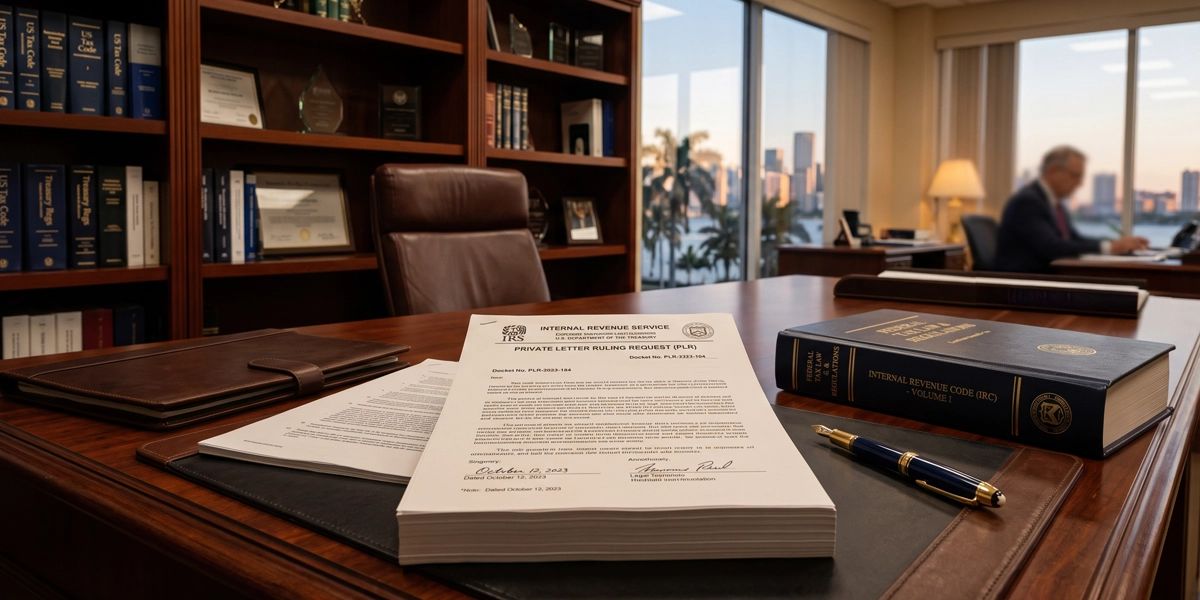
A PLR is the IRS's written answer to one taxpayer's question, binding on the IRS for that taxpayer and that transaction. Here is what it takes to get one, what it costs, and where its limits lie.
What a Private Letter Ruling Is
A private letter ruling is a written statement issued by the IRS National Office in response to a written request from a taxpayer, interpreting and applying the tax laws to that taxpayer's specific set of facts (26 U.S.C. § 6110; 26 C.F.R. § 601.201). Its appeal is easy to state: a PLR provides the taxpayer with certainty as to how the IRS will treat a proposed or completed transaction, and it binds the IRS with respect to that taxpayer for that transaction.
Table of Contents
Two qualifications frame everything else. A PLR is not a regulation or a published ruling, and other taxpayers may not rely on it as precedent. And its protection runs only as far as the taxpayer's candor: the ruling shields the requesting taxpayer against later IRS challenge on the issue addressed only if all relevant facts were fully and accurately disclosed.
When a PLR May Be Requested, and When the IRS Will Not Rule
A ruling may be requested before or after a transaction is completed, but the door closes once a dispute begins: the IRS will not issue a ruling if the issue is already under examination, in Appeals, or in litigation. In practice, a ruling request is most useful when three things line up: the tax consequences of a transaction are uncertain, the transaction involves significant tax liability, and the taxpayer wants certainty before proceeding or before reporting the transaction.
The questions PLRs address are as varied as the Code itself. To take illustrative examples of the kind that arise in closely held business and partnership settings: whether the IRS will respect the parties' treatment of a transfer as a capital contribution rather than something else, whether the cancellation of a related-party note generates cancellation-of-debt income, or whether the parties' historical capital account treatment is consistent with how a restructured arrangement is being characterized. Each of these is the sort of specific, answerable question a ruling request is built around.
What a Ruling Request Must Contain
A PLR request is a substantial document with prescribed contents (26 C.F.R. § 601.201):
- A complete statement of all relevant facts, including names, addresses, taxpayer identification numbers, organizational structure, relationships among the parties, dates, amounts, and all agreements, instruments, and documentation related to the transaction.
- A detailed description of the transaction, including the business purpose, the economic substance, the tax consequences claimed, and the specific tax treatment requested.
- A statement of the specific ruling or rulings requested, framed as one or more clear, answerable questions, for example: “Will the IRS respect the treatment of the transfer as a capital contribution for federal income tax purposes?”
- Legal analysis and supporting authorities, including citations to the Internal Revenue Code, Treasury Regulations, revenue rulings, revenue procedures, case law, and other authorities supporting the requested ruling.
- Representations and declarations, including a penalties-of-perjury declaration that all facts presented are true, correct, and complete, and that no material fact has been omitted.
- Required exhibits, including copies of all relevant agreements, amendments, organizational documents, financial statements, tax returns, and other supporting documents.
- The user fee, as required by section 7528 of the Internal Revenue Code and the applicable revenue procedure. The fee is non-refundable.
The penalties-of-perjury declaration is not a formality. The ruling's protection depends on complete and accurate disclosure, so the request is only as strong as its statement of facts.
How the Process Works
- Preparation and submission. The taxpayer or the taxpayer's representative prepares the request in accordance with Revenue Procedure 2024-1 (or the applicable year's revenue procedure) and submits it to the IRS National Office.
- Assignment and review. The IRS assigns the request to a branch within the Associate Chief Counsel's office and to a reviewing attorney, who may request additional information, clarification, or supplemental submissions.
- Conference rights. The taxpayer may request one or more conferences with the IRS to discuss the facts, the law, and the requested ruling.
- Draft ruling. The IRS prepares a draft ruling and may share it with the taxpayer for comment.
- Final ruling. The IRS issues a final ruling letter, binding on the IRS with respect to the requesting taxpayer and the specific transaction described, provided the transaction is carried out substantially as described.
Timing. The process typically takes six months to one year or longer, depending on the complexity of the issue, the workload of the reviewing branch, and whether the IRS requests additional information or conferences. The IRS does not guarantee a specific timeframe, a point that matters enormously for live transactions on a closing schedule.
What It Costs
Two layers of cost apply. First, the IRS user fee under section 7528, which is non-refundable and varies with the type of request, the number of issues, and the taxpayer's gross income. As of 2024, the user fee for a standard PLR request ranged from approximately $2,500 to $38,000, and the fee for a request involving partnership or LLC issues, including contribution, distribution, or debt-versus-equity questions, was typically in the $10,000 to $30,000 range. Current-year fee schedules are published in the applicable revenue procedure.
Second, professional fees. Preparing a ruling request requires significant legal and accounting work: factual investigation, legal research, drafting, and coordination with the IRS through review, conferences, and supplemental submissions. Professional fees for preparing and prosecuting a PLR request typically range from $25,000 to $100,000 or more, depending on the complexity of the transaction, the number of issues, the factual development required, and the need for conferences. Combined, a ruling is a five-figure undertaking at minimum, which is why the decision usually turns on whether the tax dollars at stake, and the value of certainty, justify the investment.
Limitations and Risks
- No guarantee of a favorable ruling. The IRS is not required to rule favorably and may decline to rule or issue an adverse ruling. After an adverse ruling, proceeding with the transaction as proposed means incurring the adverse tax consequences the ruling identified.
- Binding only on the IRS. A PLR binds the IRS but not the taxpayer, who may take a different position on the return, though doing so invites IRS challenge, penalties, and interest.
- Public disclosure. PLRs are made publicly available after redaction of identifying information under section 6110. Names and identifying details are removed, but the substance of the transaction and the IRS's analysis become public.
- No ruling on certain issues. The IRS will not rule on issues that are inherently factual, issues that are the subject of pending regulations, or issues on which it has announced it will not rule.
- Penalties remain possible. If the IRS later determines the taxpayer substantially understated its tax liability, accuracy-related penalties under section 6662 can apply even where a PLR was obtained, unless the taxpayer meets the reasonable-cause and good-faith exception of section 6664.
What Taxpayers Commonly Consider Instead of, or Alongside, a PLR
Because of the cost, timing, and no-rule limitations, the ruling request is one option among several, and the alternatives frequently appear in the same conversation.
- Disclosure on the return. Under section 6662, the accuracy-related penalty for a substantial understatement generally does not apply to a position that was adequately disclosed on the return and had a reasonable basis. Disclosure may reduce penalty risk, although it does not eliminate the risk of an IRS challenge to the position itself.
- A written tax opinion. A contemporaneous written opinion from a qualified adviser analyzing the technical merits of the position can support a reasonable-cause defense to penalties under section 6664 if the IRS later challenges the position. We discuss how opinion letters work, and how they compare with rulings, in our companion article on federal tax opinion letters.
- Documentation discipline. Where no ruling is pursued, complete and accurate books and records reflecting the treatment taken, the basis allocations, the capital account reconciliation, and all supporting facts become critical in the event of an audit. The position is defended years later on the paper created now.
THE ESSENTIAL TRADE: A PLR is the strongest form of advance certainty available, an answer that binds the IRS itself, purchased at the price of time (often six months to a year or more), money (user fee plus professional fees), public disclosure in redacted form, and the possibility that the answer is no.
Frequently Asked Questions
What is a private letter ruling?
A private letter ruling is a written statement issued by the IRS National Office in response to a written request from a taxpayer, interpreting and applying the tax laws to that taxpayer's specific set of facts. It provides certainty as to how the IRS will treat a proposed or completed transaction and binds the IRS with respect to that taxpayer for that transaction, provided the taxpayer fully and accurately disclosed all relevant facts.
Is a private letter ruling binding?
A PLR binds the IRS with respect to the requesting taxpayer and the specific transaction described, provided the transaction is carried out substantially as described and all relevant facts were fully and accurately disclosed. It does not bind the taxpayer, and it is not a regulation or published ruling, so other taxpayers may not rely on it as precedent.
How long does a private letter ruling take?
The PLR process typically takes six months to one year or longer, depending on the complexity of the issue, the workload of the reviewing branch, and whether the IRS requests additional information or conferences. The IRS does not guarantee a specific timeframe.
How much does a private letter ruling cost?
The IRS charges a non-refundable user fee under section 7528 that varies with the type of request, number of issues, and the taxpayer's gross income; as of 2024, standard PLR user fees ranged from approximately $2,500 to $38,000, with partnership and LLC issues typically in the $10,000 to $30,000 range. Professional fees for preparing and prosecuting a request typically range from $25,000 to $100,000 or more depending on complexity.
Will the IRS rule on any tax question?
No. The IRS will not issue a ruling if the issue is already under examination, in Appeals, or in litigation, and it will not rule on certain issues at all, including issues that are inherently factual, issues that are the subject of pending regulations, and issues on which it has announced it will not rule.
Are private letter rulings public?
Yes. PLRs are made publicly available by the IRS after redaction of identifying information. The substance of the transaction and the IRS's analysis are disclosed, although party names and identifying details are redacted.
Advance Tax Certainty: Finding the Right Path for Significant Transactions
AnidjarLaw works with taxpayers on whether a private letter ruling, a written opinion, disclosure, or another approach fits a significant tax question, and on preparing and prosecuting ruling requests. If the questions discussed here touch your own situation, we are glad to help you understand how they apply. Reach us at (954) 900-9871 or .
CONTACT US NOWRelated Reading from AnidjarLaw
Federal Tax Opinion Letters: What They Are, What They Do, and How They Are Used
Primary Sources and Further Reading
- 26 U.S.C. § 6110 - Public inspection of written determinations
- 26 U.S.C. § 7528 - Internal Revenue Service user fees
- 26 C.F.R. § 601.201 - Rulings and determination letters
- IRS: Understanding IRS Guidance, A Brief Primer
This article is general information about federal tax procedure, not legal or tax advice for any particular situation, and reading it does not create an attorney-client relationship. User fees and procedural requirements are set by the IRS and change; the figures above reflect the sources reviewed (fee ranges as of 2024) and current-year amounts appear in the applicable revenue procedure. Whether a ruling request is worthwhile, and how it should be framed, depends on specific facts that deserve individual analysis.
