


This is Part 1 of our 2026 Florida Property Tax Series.
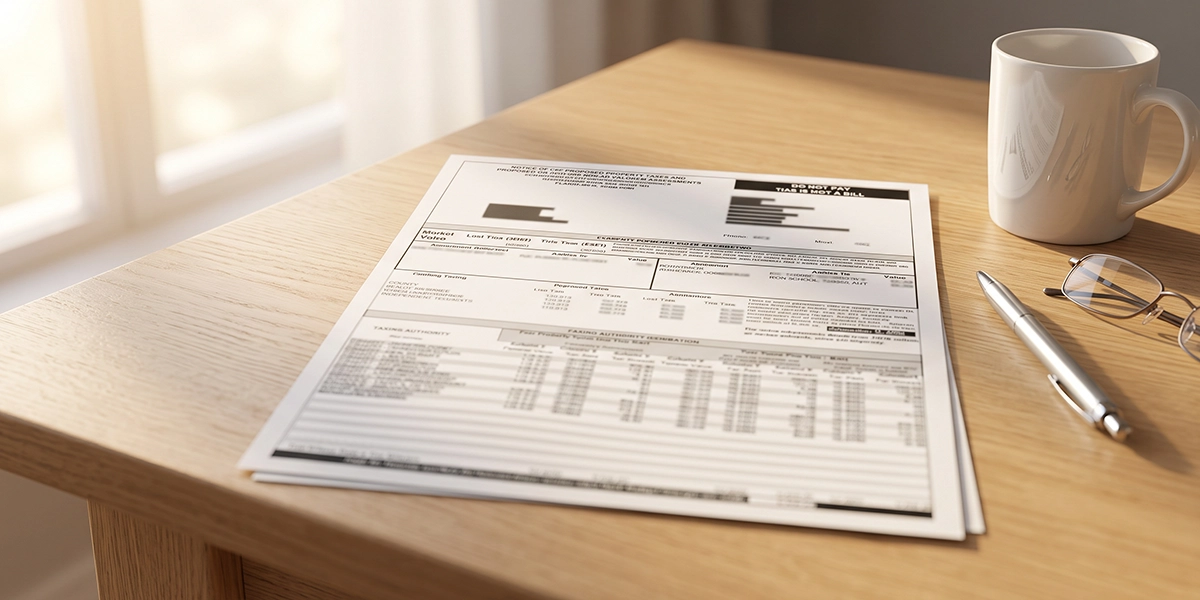
A higher number on a Florida TRIM notice can result from a rising market, a transfer that reset an assessment cap, a new improvement, or a lost exemption. Those causes are legally different, and they call for different responses. The first task is to identify which number changed and why.
Table of Contents
- 2026 Deadlines to Challenge Market or Assessed Value
- What the TRIM Notice Is, and Is Not
- Read the Three Value Lines in Order
- How Florida's Assessment Caps Work
- Why a Purchase or Transfer Can Produce a Large Jump
- Improvements, Damage, and Reconstruction
- Portability Can Preserve Part of a Homestead Benefit
- Common Triggers Behind a Surprising Notice
- What a First Review Typically Covers
- When Professional Review Often Makes Sense
- Frequently Asked Questions
2026 Deadlines to Challenge Market or Assessed Value
| County | 2026 Valuation-Petition Deadline |
|---|---|
| Broward | September 18, 2026 |
| Miami-Dade | September 18, 2026 |
| Palm Beach | September 14, 2026 |
| Collier | September 11, 2026 |
| Lee | September 11, 2026 |
What the TRIM Notice Is, and Is Not
The Notice of Proposed Property Taxes, commonly called the TRIM notice, is a preview rather than the final tax bill. It reports the Property Appraiser's values and exemptions, the taxing authorities' proposed millage rates, and hearing information. The Property Appraiser determines value and administers exemptions and caps; taxing authorities set millage; the Tax Collector sends and collects the bill. A VAB valuation petition challenges value or assessment treatment, not a policy disagreement with a tax rate.
Read the Three Value Lines in Order
Just or market value
Just value is the Property Appraiser's estimate of market value as of January 1 of the tax year: in the statute's terms, the amount a willing purchaser would pay a willing seller, exclusive of reasonable fees and costs of purchase, in an arm's-length transaction. Florida law requires consideration of the eight factors in Fla. Stat. § 193.011, including present cash value, highest and best use, location, size, cost and present replacement value of improvements, condition, income generated by the property, and net proceeds from comparable sales. A later sale or hurricane may be informative, but the legal question remains what the property was worth on January 1.
Assessed value
Assessed value is the figure after a constitutional or statutory assessment limitation is applied, and it may be significantly lower than just value where a cap has been in place for years. That gap is sometimes called accumulated benefit. A market-value increase therefore may not produce an equal assessed-value increase. Conversely, a change of ownership can remove a cap and cause assessed value to move sharply toward market value.
Taxable value
Taxable value is generally assessed value minus exemptions that apply to a particular levy. The same parcel can have different taxable values for school and non-school levies because some exemptions and assessment limitations do not apply uniformly. The basic $25,000 homestead exemption applies to all levies; the additional homestead exemption under Fla. Stat. § 196.031(1)(b), which is inflation-adjusted under current law, applies only to non-school levies. A homestead property's taxable value for school district taxes can therefore be higher than its taxable value for other taxes even though both recognize the Save Our Homes limitation.
How Florida's Assessment Caps Work
For qualifying homestead property, meaning the owner holds title, lives there permanently as of January 1, and has applied for the exemption, the Save Our Homes limitation under Fla. Const. Art. VII, § 4 and Fla. Stat. § 193.155 generally limits annual increases in assessed value to the lower of 3 percent or the percentage change in the Consumer Price Index specified by law, and it applies automatically once the homestead exemption is received. It does not cap market value or the tax bill: a higher millage rate, a new non-ad valorem assessment, an improvement, or loss of an exemption can still increase the amount due.
For qualifying non-homestead residential property (generally residential property with nine or fewer dwelling units that does not receive the homestead exemption, such as rentals, vacation homes, and second residences), Fla. Stat. § 193.1554 generally limits annual assessment increases to 10 percent for levies other than school district levies. Qualifying commercial, industrial, and other nonresidential property has a parallel 10 percent limitation under Fla. Stat. § 193.1555, with reassessment at just value following a change of ownership or control or a qualifying improvement that increases just value by at least 25 percent. Neither 10 percent limitation applies to school district levies, so the same property can carry one value for school taxes and a lower capped value for everything else. These limitations also do not provide the portability benefit available for qualifying homestead property, and classification rules, such as agricultural use, operate differently and should not be treated as another version of the 10 percent cap.
Why a Purchase or Transfer Can Produce a Large Jump
Florida reassesses property at just value following a statutory change of ownership or control. A purchase is the clearest example, and for homestead property the statute reaches any sale, foreclosure, or transfer of legal or beneficial title. For non-homestead property, a cumulative transfer of control or of more than 50 percent of the ownership of the entity that owned the property when it was last assessed at just value can also trigger reassessment. Deeds between family members, transfers into or out of certain trusts or entities, changes in beneficial ownership, divorce arrangements, inheritance planning, and corporate-control changes all can require analysis. The deed label alone does not decide the result.
Just as important, some transfers are excluded by statute. For homestead property, exclusions generally include transfers to correct an error; transfers between legal and equitable title where no additional person applies for the homestead exemption; transfers in which the owner appears as both grantor and grantee and others are merely added, unless a newly named grantee applies for the exemption; transfers between spouses, including to a surviving spouse or upon dissolution of marriage; and the addition or removal of a name to facilitate estate planning or refinancing where the person previously entitled to the exemption remains entitled to it. Non-homestead property has its own list, including an exclusion for publicly traded companies whose shares turn over on an exchange.
The timing often surprises buyers. A seller's capped assessed value may remain on the tax roll for the year of sale, while the following January 1 assessment reflects the buyer's ownership and may reset closer to market value. A closing estimate based on the seller's taxes can therefore materially understate the buyer's future carrying cost.
Improvements, Damage, and Reconstruction
New construction and substantial improvements may be added to assessed value even when the existing property is capped, generally as of the first January 1 after substantial completion. Repairs that merely preserve existing property can be treated differently from additions or upgrades. Following casualty damage, the January 1 condition, demolition, repairs, insurance documentation, permits, photographs, and construction scope may all matter.
Disaster-reconstruction rules are technical and are changing. For the 2026 roll, a replacement homestead improvement may generally retain its prior assessment treatment when reconstruction is commenced within the applicable statutory period and the rebuilt property does not exceed 110 percent of the original square footage or 1,500 total square feet, whichever is greater, with any excess assessed at just value. Beginning with the 2027 roll, amendments generally raise those thresholds to 130 percent or 2,000 square feet and extend the commencement period to five years after the January 1 following the damage. Non-homestead residential and nonresidential property have separate tests. Owners rebuilding after a storm are generally best served by advice tied to the applicable roll year rather than a general rule of thumb.
Portability Can Preserve Part of a Homestead Benefit
A qualifying Florida homestead owner who establishes a new Florida homestead within the statutory period, generally three years, may transfer, or “port,” up to $500,000 of accumulated Save Our Homes benefit to the new homestead if timing and application requirements are satisfied. Portability does not transfer the old tax bill or guarantee the same assessed value: the calculation depends on whether the owner moved up or down in value, the prior benefit, ownership interests, and filing history, and if the gap between the new homestead's just and assessed values would exceed $500,000, the assessed value is adjusted so the difference equals exactly $500,000. A missing or denied portability application can look like an excessive market value even when the real dispute concerns assessment treatment.
Common Triggers Behind a Surprising Notice
- The property was purchased in 2025 and the 2026 assessed value rose dramatically.
- A deed, trust, estate, divorce, LLC, or family transfer occurred.
- The property record lists incorrect living area, use, condition, quality, or improvements.
- A homestead exemption, Save Our Homes benefit, or portability amount disappeared.
- A renovation, addition, demolition, or storm repair was recently completed.
- Market value rose modestly, but taxable value or proposed taxes rose much more.
What a First Review Typically Covers
- Comparing current and prior just, assessed, and taxable values line by line.
- Identifying every exemption and the levies to which it applies.
- Reviewing the property record card, deed history, permits, sketches, and ownership records.
- Separating a valuation issue from a cap, exemption, classification, portability, or millage issue.
- Asking the Property Appraiser for an informal explanation, with the VAB deadline calendared first, because the informal process does not stop the clock.
A market-value increase, a cap reset, a data error, and a lost exemption can all produce the same alarming number, but they are corrected through different remedies with different deadlines.
When Professional Review Often Makes Sense
Professional review tends to be especially useful when a transfer was part of estate or trust planning, when ownership is held through an entity, when the assessment reset unexpectedly, when portability is disputed, or when an improvement or casualty raises mixed legal and appraisal questions. The value of a successful correction may compound over future years, but the proper remedy and deadline depend on the type of error.
Frequently Asked Questions
What is a Florida TRIM notice?
The Notice of Proposed Property Taxes, commonly called the TRIM notice, is a preview rather than the final tax bill. It reports the Property Appraiser's values and exemptions, the taxing authorities' proposed millage rates, and hearing information. A VAB valuation petition challenges value or assessment treatment, not a policy disagreement with a tax rate.
What is the difference between just value, assessed value, and taxable value?
Just value is the Property Appraiser's estimate of market value as of January 1 under the factors in section 193.011. Assessed value is the figure after a constitutional or statutory assessment limitation is applied, which can be significantly lower than just value. Taxable value is generally assessed value minus exemptions that apply to a particular levy, and the same parcel can have different taxable values for school and non-school levies.
How does the Save Our Homes cap work?
For qualifying homestead property, Save Our Homes generally limits annual increases in assessed value to the lower of 3 percent or the percentage change in the Consumer Price Index specified by law. It does not cap market value or the tax bill: a higher millage rate, a new non-ad valorem assessment, an improvement, or loss of an exemption can still increase the amount due.
Why did my assessment jump after I bought the property?
Florida reassesses property at just value following a statutory change of ownership or control. A seller's capped assessed value may remain on the tax roll for the year of sale, while the following January 1 assessment reflects the buyer's ownership and may reset closer to market value. A closing estimate based on the seller's taxes can therefore materially understate the buyer's future carrying cost.
What is Save Our Homes portability?
A qualifying Florida homestead owner who establishes a new Florida homestead within the statutory period, generally three years, may transfer up to $500,000 of accumulated Save Our Homes benefit to the new homestead. The calculation depends on whether the owner moved up or down in value, the prior benefit, ownership interests, and filing history. Portability does not transfer the old tax bill.
A short filing window rewards early, disciplined review. AnidjarLaw works with Florida property owners on assessment analysis, legal and factual issues, valuation evidence, and VAB petitions and related strategy. If the questions discussed here touch your own property, we are glad to help you understand how they apply to your situation.
CONTACT US NOW2026 Florida Property Tax Series
You are reading Part 1. The series continues with two more installments before the earliest VAB deadlines:
Primary Sources and Further Reading
Current as of August 20, 2026. Deadlines and filing requirements can change; confirm statutes and county instructions directly.
- Florida Statutes, Chapter 193
- Florida Statutes, section 196.031
- Florida Department of Revenue, Property Tax Oversight
Legal disclaimer: This article provides general information, not legal, tax, or appraisal advice. It does not create an attorney-client relationship. Outcomes depend on the facts, evidence, applicable law, and local procedures. Deadlines and filing requirements can change; confirm them directly with the appropriate Value Adjustment Board.
